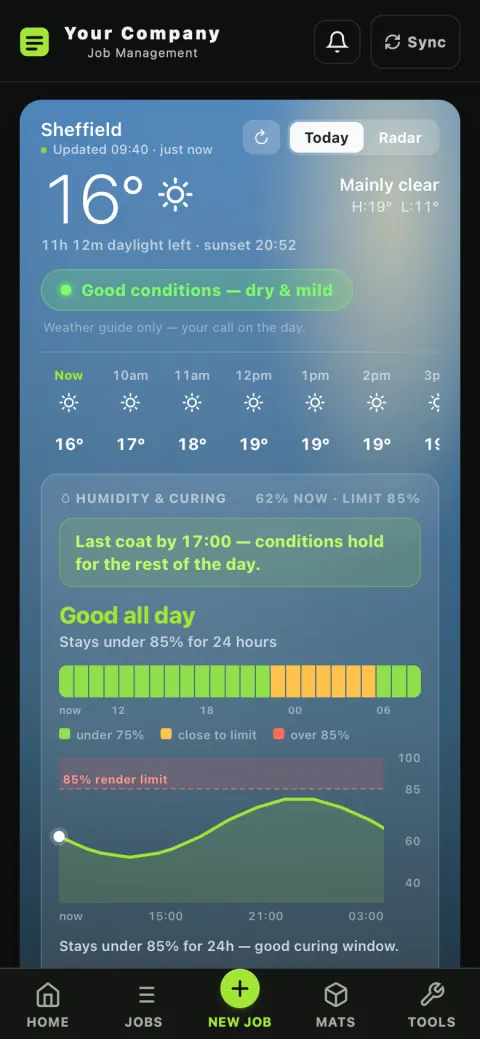
A general weather app tells you it's 14 degrees and a 20% chance of rain. That isn't the question. The question is whether this system, on this wall, this morning will cure — and whether what you put on at four o'clock will still be there tomorrow. PlasterFlow answers that one.

The card gives you Good conditions, Take care or Not ideal — and always says why: “too cold — below 5°C”, “frost risk overnight”, “humid 88% — slow cure”. A verdict without a reason is just a colour.
It's worked out on the limits the manufacturers actually publish, not on whether it feels nice out:
| What it checks | The rule it uses |
|---|---|
| Temperature | Above 5°C and below 30°C. It judges “too hot” on the temperature now, not the afternoon peak, so the banner matches the number you're looking at. |
| Frost | The overnight low, not the daytime high — because frost within the curing window is what wrecks a fresh coat, and that happens after you've gone home. |
| Humidity | Under 85%. Silicone and acrylic finishes cure slowly and a damp still day is the classic way to end up with patchy colour. |
| Rain | Forecast rainfall in millimetres — see below. Rain washes fresh render off the wall. |
This is the detail that took the longest to get right, and it's the one that matters most on green render.
In the same forecast response, the chance of rain and the amount of rain are two separate numbers, and they don't have to agree. A real case: one town showed 6% and 0.00mm while a town 40 miles away showed 4% and 0.40mm. Read the percentage and you'd have called both of them dry. One of them wasn't.
So the verdict runs on the millimetres. Any measurable rainfall in the forecast window pushes the risk up regardless of what the percentage says — a tenth of a millimetre is enough to mark fresh render, so there's no “small enough to ignore” threshold.
As well as the general forecast it pulls the Met Office's own 2km UK model — the fine-grained one built for this country's weather — and takes the worse of the two, hour by hour. When they disagree about a shower, you hear about the shower.
Flip the card to Radar and watch the actual rainfall moving across the map. It also checks the radar over the job directly, so “it's raining now” is something the app can know rather than forecast.
On the phone you can be told roughly 40 minutes before rain reaches you — enough to get the sheets on or stop mixing.
An optional morning notification: today's job, today's verdict, what needs chasing. Off by default — it's a tool, not a nag.
The one you ask yourself on the scaffold: is there time for one more, or am I coming back tomorrow?
A strip of the next 24 hours, colour-coded under 75%, close to the limit and over 85%, with the 85% line drawn across the graph. You can see the damp coming in at nine o'clock tonight.
From the humidity curve and the temperature it works out the last useful coat of the day — and tells you plainly whether conditions hold for the rest of the day or fall away.
If the job you're on uses an all-weather mix, the temperature and humidity limits relax to match its datasheet — down to −5°C and humidity to 99% — while rain still counts, because rain always counts. The card says “all-weather” so you know which rules you're being judged by.
The curve starts from the temperature and humidity being reported now, so the graph and the big number on the card never disagree with each other.
Your phone's location on the app, or the area you've saved if you'd rather not share GPS. Either way it's the weather at the job, not at the nearest city.
Each of the next seven days carries its own verdict, so booking a render week is a decision you can make on Thursday rather than hope about on Monday.
14 days free, no card. Open it on a doubtful day and see whether you agree with it — that's the only test worth doing.